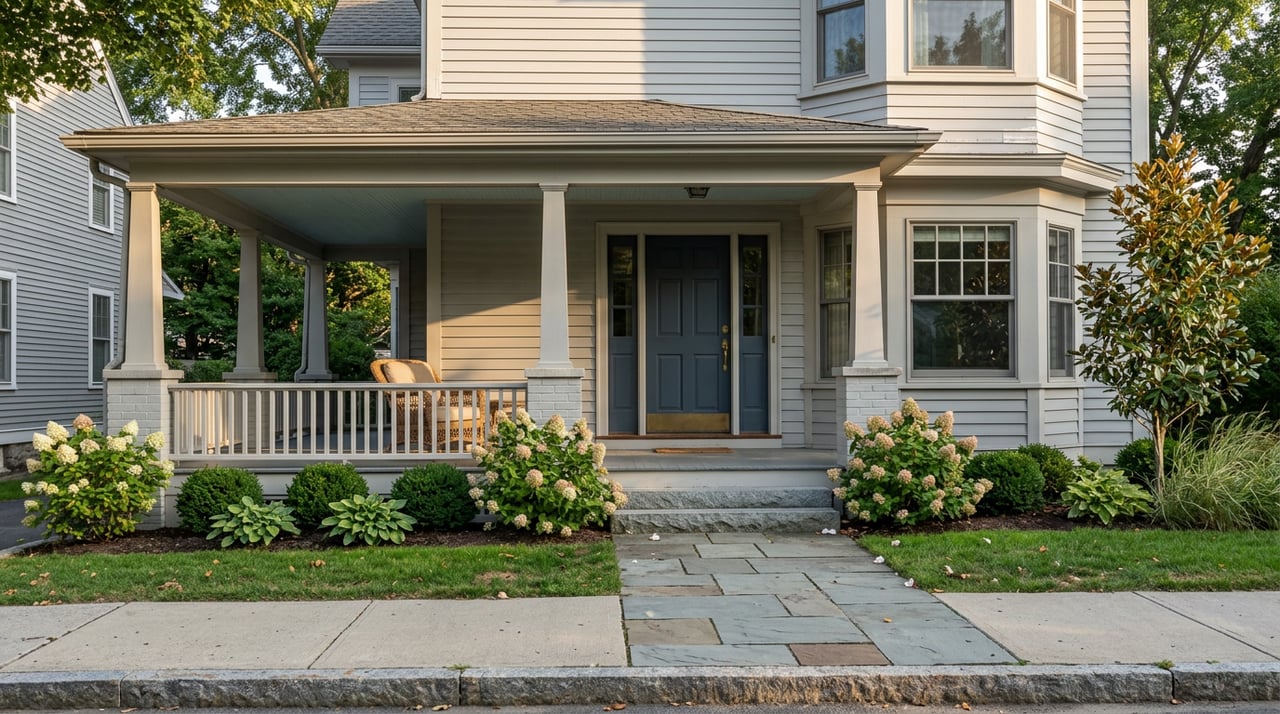
A buyer emailed us last month with two listings pulled up side by side. Both in South Portland. Both under a mile from the Casco Bay Bridge. One had gone under contract in nine days. The other had been sitting for six weeks with a price cut already posted. She wanted to know which one reflected the "real" South Portland market.
Neither did. That's the point.
South Portland gets reported as a single number everywhere you look, and depending on which tracker you check, that number moves quite a bit. Redfin had the median sale price at $535,000 over the three months ending in May 2026, down slightly from the year before. Zillow's home value estimate sat at $540,160 as of the end of June, up 2.5% year over year. Movoto put the July 2026 median at $602,499. Three trackers, three different windows, three different numbers, all describing the same city in the same season.
That spread isn't a data error. It's a symptom. South Portland is stitched together from neighborhoods with genuinely different housing stock, different buyer pools, and different pricing behavior, and averaging them into one citywide figure smooths over the exact information a buyer or seller actually needs.
The Gap That Actually Matters: 11 Days vs. 34
Here's the number worth sitting with. Homes in Knightville have been selling in an average of 11 days, against South Portland's citywide average of 34 days on market over the same recent stretch. For comparison, homes across Maine statewide were taking a median of 53 days as of May 2026. Knightville isn't just faster than the state. It's moving at roughly a third of its own city's pace.
That's not random noise. Two things are driving it. First, Knightville is in the middle of a real construction cycle, not a hypothetical one. A townhouse project reusing a previously underutilized lot near the village center is delivering historically styled, energy-efficient units with two-car garages and EV charging, built explicitly to read as "West End charm" at a South Portland price point. New, move-in-ready inventory in a walkable node tends to absorb fast, and it's pulling the whole micro-market's pace with it.
Second, Knightville sells a lifestyle that Portland buyers already recognize, at a discount they can act on quickly. It's a five-minute drive or a flat, roughly two-mile walk or bike ride across the Casco Bay Bridge into Portland's West End, and it comes with its own dense cluster of everyday reasons to stay local: Taco Trio and OTTO Pizza for dinner, Red's Dairy Freeze for the kind of stop that becomes a summer habit, Mast Landing Brewing Company for a Friday pint, Nonesuch Books and Bull Moose for the browsing errands that don't feel like errands. Mill Creek Park anchors the neighborhood physically, with ice skating in winter, a summer concert series, an annual tree lighting, and Art in the Park each August drawing more than 150 artists. The South Portland Farmers' Market runs Sunday mornings from mid-May through October, then moves indoors for winter. None of that shows up in a median price. All of it shows up in how fast a listing moves.
The regional pattern backs this up. Knightville and Mill Creek have been appreciating 5 to 7% annually, well ahead of the 2 to 3% typical of what one Greater Portland market analysis called the region's more commoditized suburban tracts. That's not a coincidence tied to a single hot month. It's a multi-quarter trend, and it means the "South Portland discount" relative to Portland proper is compressing in these specific pockets faster than it is elsewhere in the city.
Willard Square's Scary Headline Is a Sample Size Problem
Now the neighborhood that tells the opposite story, for the opposite reason.
Willard Square's most recent tracked month showed a median sale price of $578,000, reported as a 24.8% drop from the year before. Read on its own, that looks like a neighborhood in retreat. It isn't. In the comparison month, only eight homes sold in Willard Square, up from four the year before. Days on market rose from 6 to 29 over the same stretch.
Eight sales is not a market. It's a small enough number that one large historic waterfront-adjacent home selling in one month and a handful of smaller cottages selling in the next can swing the median by six figures without any actual shift in what buyers are willing to pay for comparable properties. The "24.8% drop" is a mix-shift artifact, not a correction. The rise in days on market from 6 to 29 is a more honest signal, and even that is thin enough that a single well-priced listing next month could reset it back toward single digits.
This matters beyond Willard Square specifically. Any neighborhood with a low sales count, and several of South Portland's named pockets qualify, will throw off headline percentages that look dramatic and mean very little. If you're comparing neighborhoods using a monthly year-over-year stat, ask how many transactions that percentage is actually built on before you let it change your strategy.
The Rest of the Map
Beyond Knightville and Willard Square, South Portland breaks into a few more distinct pockets worth knowing by name rather than lumping into the city median.
Ferry Village sits along the harbor and marina, an easy walk to Knightville's restaurants and shops, with a mix of condo conversions and cottages that trade on salt air and proximity rather than square footage. Meetinghouse Hill leans toward classic South Portland ranch homes, the kind of listing that tends to move quickly when it's priced to reflect its condition rather than its zip code. Breakwater is home to Southern Maine Community College and carries a different rhythm again, shaped as much by the campus as by the water.
The city overall still functions as what one local guide accurately called a smaller, quieter alternative to Portland proper, a fifteen-minute drive from downtown, with a working waterfront, a historic lighthouse over Portland Harbor, an oil port and rail yard. Condo pricing across the city spans from the upper $100,000s to the upper $800,000s for luxury units, and single-family homes range from the mid-$200,000s past $1 million, with genuine waterfront parcels rare enough that they don't come up often. That range alone should be a signal that "the South Portland median" was never going to describe any specific street very well.
What This Means If You're Actually Pricing a Home Here
If you're comparing South Portland to other towns in Greater Portland, or comparing its neighborhoods to each other, the citywide median is a starting point at best. The more useful questions are neighborhood-specific. How many comparable homes actually sold in this pocket in the last few months, not the last year. What was the sale-to-list ratio on those, not just the asking price. Is new construction or a recent redevelopment absorbing inventory in a way that's compressing days on market, the way it is in Knightville right now.
Current mortgage rates in the 6.5 to 7% range are shaping buyer behavior across the whole region, but the neighborhood-level mechanics we're describing here sit on top of that broader rate story, not underneath it. A rate move changes what buyers can afford everywhere at once. A construction cycle or a thin sales count changes what a specific street is doing right now.
A Few Questions Worth Asking Before You Commit to a Number
Does Knightville's speed mean I should expect a bidding war? Not automatically. Fast absorption from new construction and proximity demand is a different mechanism than a true bidding war, though multiple offers do happen on well-priced, move-in-ready listings in the neighborhood. The distinction matters for how you approach an offer.
If Willard Square's median dropped nearly 25%, doesn't that mean prices are actually falling there? Not based on what the data shows. With only eight sales in the comparison month, that percentage reflects which specific homes happened to sell, not a shift in what comparable properties are worth. Watch days on market and sale-to-list ratio over a longer window before drawing conclusions from one month's median.
Which South Portland neighborhood should I be looking at? That depends on what you're optimizing for. Someone prioritizing walkability to restaurants and a fast close should look hardest at Knightville and Ferry Village. Someone chasing waterfront proximity in a slower-moving, lower-inventory pocket should expect Willard Square's pace and price to swing more than the headlines suggest.
South Portland rewards buyers and sellers who think in neighborhoods, not city averages. If you want a read on what a specific street or pocket is actually doing right now, rather than what the citywide median implies, the team at Beautiful Maine Home can walk you through it. Request a complimentary home valuation and we'll show you the numbers that actually apply to your address.